top of page

GravityKills Classroom
STEP 1 - Identify the Changing Quantity
Determine which physical quantity changes during the process and will be described by the differential equation.
Examples
-
Position - x
-
Velocity - v
-
Charge - q
-
Current - i
This variable will eventually appear in the integral on one side of the equation, while time appears in the integral on the other side.
STEP 2 - Write the Governing Physics Equation
Using fundamental physics principles, write an equation that describes the problem. Such as a summation of forces or summation of voltage gains and drops (loop rule) or conservation of energy.
STEP 3 - Replace Rates with Derivatives
Express the changing quantity as a derivative. This converts the physics equation into a differential equation.
Examples

STEP 4 - Separate Variables for FIRST-Order Derivatives
Use algebra to rearrange the differential equation so that, after multiplying both sides by the denominator differential (e.g. dt), all terms involving one variable and its differential are on one side and all terms involving the other variable and its differential are on the other.
Example - An object is slowing down due to the resistive force, -kv, where k is a constant and v is the speed of the object. Find an equation that expresses the object's speed as a function of time.

Now every speed term is on the left and every time term is on the right. Constants can be placed on either side.
Notice what happened:
-
The derivative became a differential.
-
The variables are now separated.
This process is called separation of variables.
STEP 4 - Separate Variables for SECOND-Order Derivatives
Differential equations containing second-order derivatives generally cannot be solved by separation of variables alone. Instead, a function must be found whose second derivative satisfies the differential equation and any given initial conditions.
Example - A mass attached to a spring is oscillating back and forth.
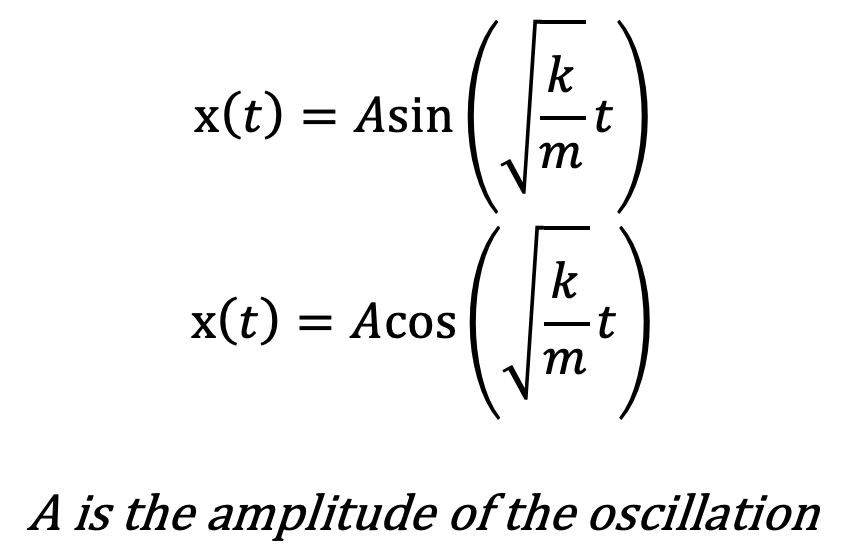
The last expression asks - What function, when differentiated twice and then added to itself, equals zero?
There are two possible functions: sine and cosine.

STEP 6 - Solve for the Desired Variable
Use algebra to isolate the unknown.
Example

www.GravityKillsClassroom.com
STEP 5 - Integrate Both Sides
Set limits of integration and integrate each side with respect to its variable and evaluate the resulting expression.
Setting Limits: The lower limit (initial value) can be zero, but the final value should be nonzero. It may be necessary to specify a variable as the upper limit (final value).
Example

bottom of page